
Creatine is a naturally occurring compound (made from the amino acids glycine, arginine, and methionine) that helps regenerate ATP – the cellular energy used in high-intensity exercise. Roughly 95% of your body’s creatine is stored in muscle, and supplementing it increases muscle phosphocreatine stores. Clinical studies show that taking ~3–5 grams of creatine monohydrate daily can boost muscle creatine by ~20–40%, enhancing strength and high-intensity performance.
In essence, creatine gives muscles more “fuel” for intense efforts, leading to better training gains over time. Since you deplete some creatine daily, supplementation is popular for athletes and gym-goers who want faster recovery and bigger gains.
Creatine supplements are widely used by athletes and fitness enthusiasts to boost strength, muscle gains, and recovery. The two most common formats are creatine powder and creatine pills (capsules). Both deliver the same active ingredient (usually creatine monohydrate) and therefore offer similar benefits for muscle energy and performance. However, they differ in how you take them. Understanding the differences between creatine pills vs powder is essential when deciding which format best aligns with your fitness goals, lifestyle, and supplement routine.
Creatine supplements are widely used by athletes and fitness enthusiasts to boost strength, muscle gains, and recovery. The two most common formats are creatine powder and creatine pills (capsules). Both deliver the same active ingredient (usually creatine monohydrate) and therefore offer similar benefits for muscle energy and performance. However, they differ in how you take them.
This guide will compare creatine pills vs powder across key factors—absorption, convenience, cost, dosage, and side effects—to help you decide which format best suits your needs.
Powder form can lead to slightly faster absorption, since the creatine dissolves in liquid before ingestion. In contrast, pills must break down in the stomach.
MyProtein notes that absorption speed isn’t critical for creatine’s effectiveness – “When you first start taking creatine… how quickly creatine is absorbed into your system doesn’t alter your workouts. …consistency is key”. In practice, both powder and pills ultimately saturate your muscles with creatine; it’s daily dosing over weeks that makes the difference, not the form. Health experts also confirm that powder and capsules “may offer the same benefits” but vary in convenience, cost, and other practical factors.
Figure: Green supplement pills spilling from a bottle – representing creatine capsules vs powder.
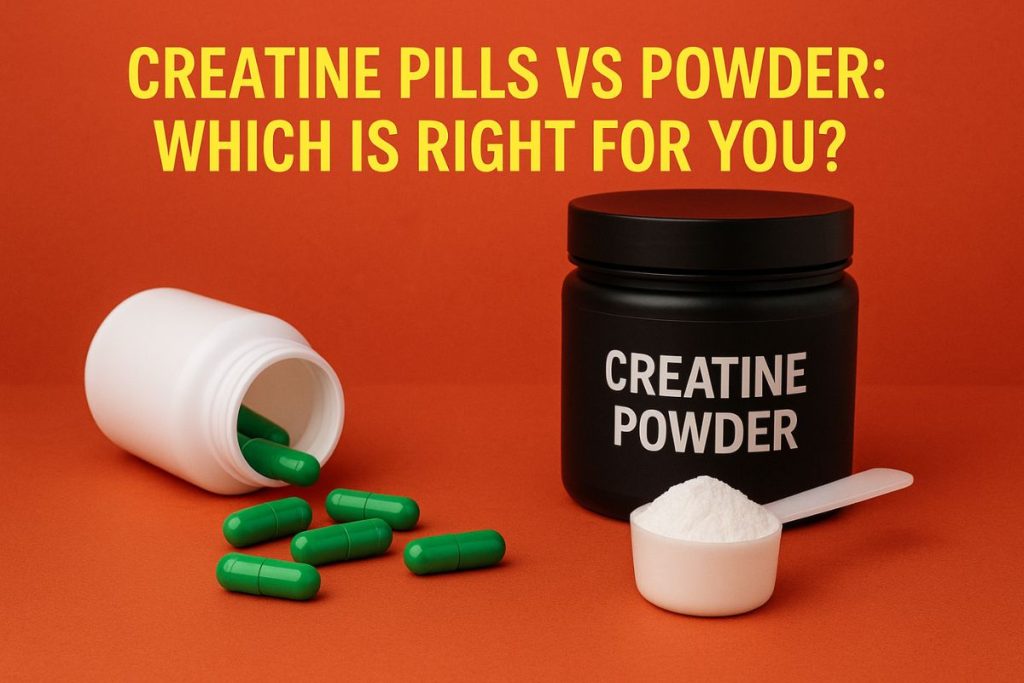
What Is Creatine and How Does It Work?
Creatine is a naturally occurring compound made from the amino acids glycine, arginine, and methionine. It plays a key role in regenerating ATP – the primary energy source for high-intensity exercise. Around 95% of your body’s creatine is stored in muscle tissue, where it supports explosive strength and quick recovery. Supplementing with creatine increases muscle phosphocreatine levels, which helps fuel intense efforts and improve overall athletic performance.
Clinical research shows that consuming 3 to 5 grams of creatine monohydrate daily can boost muscle creatine stores by approximately 20–40%. This translates into enhanced strength, better workout endurance, and faster recovery between training sessions. Because creatine is naturally depleted through physical activity, many athletes and fitness enthusiasts rely on supplementation to maintain optimal levels.
Creatine is most commonly available in two forms: powder and pills (capsules). Both options provide the same essential benefits—improved strength, endurance, and recovery—thanks to their shared active ingredient, usually creatine monohydrate. However, the two forms differ significantly when it comes to absorption speed, ease of use, dosing flexibility, and cost. Choosing between creatine pills vs powder ultimately depends on your personal preferences, daily routine, and fitness objectives. Understanding how creatine pills vs powder deliver these performance-enhancing effects will help you make an informed decision that supports your long-term training and health goals.
Aside from monohydrate, other creatine forms such as creatine HCL, nitrate, and ethyl ester are available on the market. However, research consistently shows that creatine monohydrate remains the safest, most effective, and most scientifically supported option for enhancing performance and muscle growth. In most cases, whether you’re taking a powder or a pill, the supplement will contain creatine monohydrate. The key difference in the creatine pills vs powder comparison isn’t the creatine itself—it’s how you take it. The form, whether capsule or powder, simply affects convenience, dosage control, and user preference—not the molecular structure or effectiveness of the creatine.
Advantages of Creatine Powder
Creatine powder has some key benefits for users who prefer flexibility and value:
- Faster mixing & absorption: Powder dissolves in water or juice, so it begins absorbing immediately. This means you may notice effects slightly quicker when taking powder. After a workout, liquid mixtures can enhance absorption.
- Precise dosing: You can measure out any amount. This is ideal if you follow a loading phase or split dose (e.g. 20g/day loading then 3–5g maintenance). It’s easy to adjust your intake by fractions of a scoop.
- Lower cost per gram: On average, powder is more economical. A scoop of powder usually contains a full 5g dose, whereas achieving 5g with pills may require many tablets. The manufacturing process for powder is simpler, so powder “tends to be more economical”.
- Versatility: Powder mixes well into shakes, smoothies, or even coffee. You can combine it with protein or carbs for better creatine uptake. Many users also add it to sports drinks or pre-workouts. This variety means it’s easy to incorporate into your routine.
- Bulk supply: Powder containers often hold dozens or hundreds of servings, which can be convenient for long-term supplementation (just scoop and go).
Drawbacks of Creatine Powder
However, powder also has some downsides:
- Less convenient to transport: Carrying a tub or pouch and a scoop can be cumbersome, especially when traveling or at the gym. You need access to water and a shaker or bottle for mixing.
- Potential stomach upset: If not fully dissolved, powder can cause bloating or cramping in sensitive individuals. Taking 5g at once (especially without much water) sometimes leads to minor GI issues. Splitting the dose can help.
- Weight gain (water retention): An expected effect of monohydrate is increased water in muscle cells. This “weight gain” can be temporary (mostly water) but may bother those seeking a very defined look. It occurs with powder or pills alike but is more noticeable with larger doses.
- Preparation time: Measuring and mixing takes a bit of effort. If you’re very busy or dislike the chalky texture, this can be a turn-off.
Advantages of Creatine Pills (Capsules)
Creatine pills are essentially creatine powder pre-measured into capsules or tablets. Their main benefits revolve around convenience:
- Ultra-convenient: You can pop pills with water anywhere – no mixing required. This is great for travel, work, or busy schedules. Some users keep a pill organizer or supplement bottle in a bag and never worry about shakers.
- Precise dosing (per pill): Each pill or capsule contains a fixed amount (e.g. 1–2 g). You simply take 2–3 pills per dose. This removes guesswork – every pill is a known dose.
- No taste or texture issues: Since you swallow them whole, there’s no gritty mouthfeel or odd flavor. NDL Pro-Health notes pills “do not present flavor problems, which is an advantage” for anyone sensitive to taste.
- Portable and discreet: Pills take up little space and can be taken quietly (no funneling a powder into your mouth). They’re easy to carry in a pocket or purse.
- Gentler on some stomachs: Because some capsules use enteric coatings, they can pass more easily through the stomach. The NDL guide points out pills “tend to cause fewer digestive issues” compared to powder.
Drawbacks of Creatine Pills
On the flip side, pills have a few limitations:
- Higher cost: Capsules generally cost more per gram of creatine. As NDL explains, pills are pricier “due to additional manufacturing and packaging”. You’re paying extra for the convenience.
- Multiple pills per dose: To get a 5g dose, you might need 4–5 pills (if each pill is 1g–1.25g). Swallowing that many can be uncomfortable for some. NDL notes it “may be necessary to take several pills to reach the recommended daily dose”.
- Slower absorption: Pills take a bit longer to dissolve, so absorption is slightly delayed. In practice, this has minimal effect on results, but it does mean you might feel the effect minutes slower than powder.
- Less flexible dosing: You’re locked into pill strengths. If you wanted 4g instead of 5g, you may need to open a capsule or break a tablet. Powder allows more fine-tuning.
Comparison Summary
| Factor | Creatine Powder | Creatine Pills (Capsules) |
| Convenience | Requires measuring and mixing | Easy to carry and take, no mixing needed |
| Dose Accuracy | Flexible; easily adjust by fractions | Fixed per pill; need multiple pills for full dose |
| Absorption Speed | Slightly faster (already in liquid) | Slower (must dissolve in stomach) |
| Cost | More economical (cheaper per gram) | More expensive due to processing |
| Taste & Texture | Neutral/slightly gritty taste; may need flavoring | No taste or texture issues |
| Portability | Bulky container + shaker | Compact, very portable |
| Digestive Comfort | Can cause bloating if taken improperly | Generally gentler on stomach |
Creatine pills vs powder Is Better for You?
There’s no one-size-fits-all answer – it depends on your priorities. Both creatine powder and pills offer the same core benefits (muscle strength, size, recovery). As NDL Pro-Health concludes, “both formats of creatine… are equally effective in improving physical performance, increasing muscle mass, and accelerating recovery”. The differences lie in lifestyle and preference:
- Choose powder if: You want the lowest cost per serving and the ability to fine-tune your dose. Powder is ideal if you already mix shakes or if you don’t mind carrying a container. It’s also helpful if you like combining creatine with other supplements (e.g. protein or pre-workout). Because it absorbs quickly when mixed, powder may offer a slight edge immediately after workouts.
- Choose pills if: Convenience is your top concern. If you travel, work long hours, or simply dislike scooping and cleaning shakers, pills win. They’re grab-and-go – you can even take them in a car or at a meeting without anyone noticing. Pills are also great if you have a sensitive palate; you won’t taste anything.
For example, one Reddit user considered switching to pills because “I travel a lot and it is difficult for me to get creatine in when I have to mix it… I feel like the pills would be more convenient.” This highlights a common factor in the creatine pills vs powder debate—convenience. They correctly observed that pill servings tend to be smaller (often 2.5–3.5g) versus the standard 5g scoop of powder. In other words, expect to take multiple capsules to equal a scoop. Another experienced lifter commented simply: “It doesn’t matter [pills or powder],” affirming the core point that the creatine itself is the same, regardless of form.
Ultimately, pick the form that fits your routine and budget. NDL sums it up well:
“If you value convenience and ease of use: Creatine pills are ideal… If you prefer flexibility in dosing and a lower cost: Creatine powder is more economical… Both formats can help you achieve your fitness goals effectively”.
Both forms work when taken consistently. You can even mix them – for instance, use powder most days and take pills on travel days. MyProtein emphasizes there’s “no rule that you need to choose one and stick to it”. What matters is your daily creatine total.
Other Considerations
- Hydration: Regardless of form, stay well-hydrated. Creatine pulls water into muscles, so drink plenty of fluids to avoid cramps or dehydration.
- Health Conditions: Creatine is generally safe for healthy adults, but those with kidney issues or other medical conditions should consult a doctor first.
- Creatine HCL vs Monohydrate: Some pills contain creatine hydrochloride (HCL) instead of monohydrate. HCL is more water-soluble and can use smaller doses. However, most research supports monohydrate as the gold standard. If you have stomach sensitivity, HCL powder (which dissolves very easily) might be worth trying.
- Stacking Supplements: Powder form allows easy mixing with other supplements. Many users add creatine powder to a post-workout shake. Pills, being discrete, can’t be combined in this way.
Figure: Illustration of supplement containers (whey protein, casein) and capsules – symbolizing various fitness supplements including creatine in powder and pill forms.
FAQ
Q: Are creatine pills as effective as powder?
A: Yes – both deliver the same creatine molecule (typically monohydrate). As long as you take an equivalent dose (e.g. 5g), you’ll get the same benefits. The form doesn’t change how creatine works in muscle. In fact, forum discussions (e.g. Reddit) agree that “there is no difference between pills and powder” in terms of results.
Q: Which form is cheaper? Powder or pills?
A: Creatine powder is generally cheaper per serving. Large tubs of powder yield many 5g doses at a low price. Pills cost more due to processing. For example, MyProtein notes that “creatine powder costs less per serving than creatine pills”. If budget is a concern, powder is the frugal choice.
Q: How many creatine pills equal one scoop of powder?
A: It depends on pill strength. Many capsules contain ~1–1.25g of creatine. To reach a standard 5g dose, you may need 4–5 capsules. Some products sell larger pills (e.g. 2.5g each), but you’ll still typically take multiple. Always check the label for the creatine per capsule.
Q: Can you use both forms together?
A: Yes. You can mix powder and pills as long as you keep track of total intake. For example, take a powder scoop post-workout on gym days and use pills on travel days. MyProtein’s “take home” advice is: “What will it be? Pills or powder? Or both. There’s no rule that you need to choose one and stick to it”.
Q: Do pills or powder cause more bloating?
A: Powder tends to cause more noticeable water retention and sometimes stomach upset, especially if large doses are taken at once. Pills (which often contain similar creatine amounts, just in capsule form) may be gentler on the stomach because they dissolve gradually. If bloating is an issue, try splitting your dose or consider a more soluble form (like creatine HCL).
Q: Which do bodybuilders and athletes prefer?
A: Many competitive athletes prefer powder due to cost and dosing flexibility. It’s the classic choice for heavy lifters and bodybuilders. On the other hand, casual gym-goers or busy professionals often favor pills for convenience. As one Reddit user put it: “Buy the most available one” – meaning whichever is easiest for you to obtain and use consistently.
Q: Are capsule supplements as safe as powder?
A: Yes. The safety profile of creatine doesn’t change by form. Both pills and powder are safe when taken in recommended doses. Rare side effects (like minor gastrointestinal upset) can occur with either, but both are generally well-tolerated.
Conclusion: Both creatine powder vs creatine pills deliver the same muscle-building and performance-enhancing benefits. The decision boils down to personal preference: choose powder for cost-efficiency and dose flexibility, or choose pills for supreme convenience and portability. Consider your lifestyle – if you mix drinks and don’t mind the extra weight, powder may fit best. If you’re often on-the-go or dislike measuring supplements, pills could be ideal. Remember: consistency in taking creatine is what matters most. As long as you get your daily dose of creatine (be it from powder or pills), you’ll maximize strength and recovery gains. Try one form, and if it doesn’t suit you, the other form is always an option. Which will you choose?

2 thoughts on “Creatine Pills vs Powder: Which Is Right for You?”