
Bunions (a painful bump at the base of the big toe) can make walking and standing miserable. They change the shape of your foot, so tight, narrow shoes only increase discomfort. Health experts note that about half of adults struggle with bunions, and the right footwear can alleviate pain. Good shoes for bunions should have wide toe boxes, flexible uppers, low heels, and arch support. This article reviews 10 editor-tested shoes that combine comfort and style, helping bunion sufferers walk without pain.
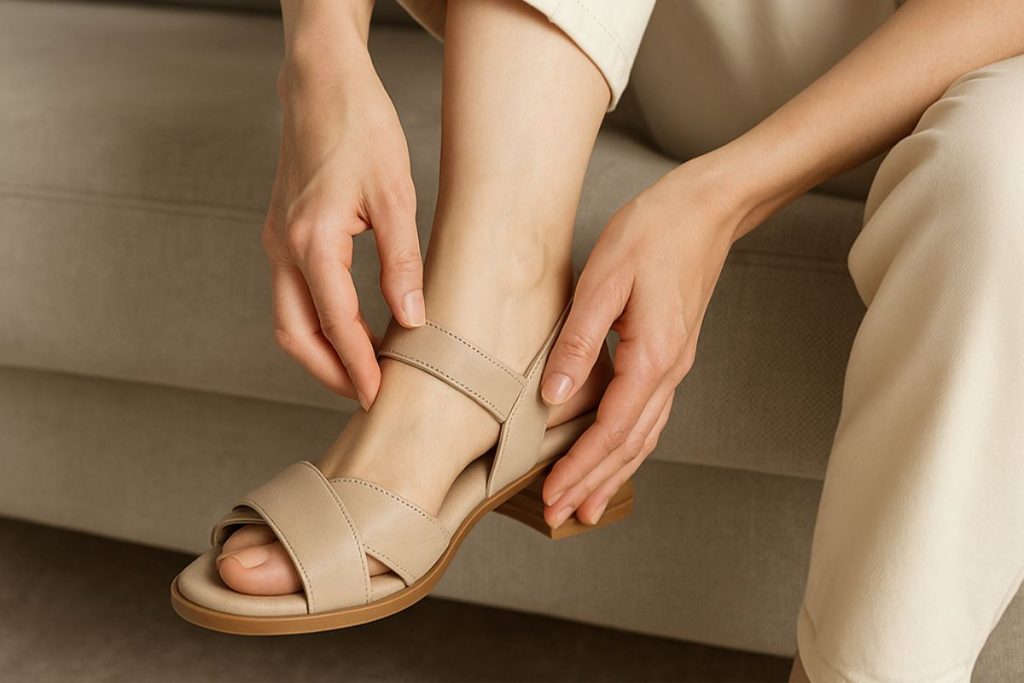
A woman adjusts her beige sandals on a couch, exemplifying stylish comfortable shoes good for bunions with supportive straps and a low heel.
Understanding Bunions and Foot Mechanics
A bunion (hallux valgus) is not a growth but a misalignment of the big-toe joint. When the big toe leans inward, the joint protrudes outward, causing pain and increasing the width of the forefoot. This deformity can also occur on the little toe (“tailor’s bunion”). Tight or high-heeled shoes worsen this misalignment by squeezing the toes and pushing weight onto the joint. Over time, ill-fitting footwear can lead to further complications (corns, hammertoes).
Practically, bunions make shoes that once fit well now feel tight at the ball of the foot. The bunion area can become red, swollen, and irritated when pressed by the shoe. Choosing “bunion-friendly” footwear is essential for comfort. As Balance Health notes, shoes must accommodate the bunion’s shape to relieve pressure.
Key Features of Bunion-Friendly Shoes
When shopping for bunion-friendly shoes, look for these features:
- Wide Toe Box: Roomy front area lets toes spread and reduces pressure on the bunion. Avoid narrow or pointed shoes that squash the toes.
- Good Arch Support: Cushioned or orthotic insoles support the arch and distribute weight evenly, keeping stress off the forefoot.
- Low Heels (<1–2 inches): Flat or low-heeled shoes keep weight off the toes. High heels should be avoided as they pitch body weight onto the bunion.
- Soft, Flexible Uppers: Breathable mesh or soft leather materials move with your foot and prevent rubbing. Stretch panels or padded interior seams can protect sensitive bunion areas.
- Cushioning and Shock Absorption: Thick midsoles (foam or gel) cushion impact and improve comfort during walking or running.
- Adjustability: Features like laces, straps or removable insoles help customize fit for swelling or orthotics.
Doctors emphasize these points. For example, podiatrist Valencia advises avoiding pointed or tight shoes and choosing a shoe with a wide toe box and flexible upper. In short, good shoes for bunions are essentially comfortable shoes for wide feet with support in the right places.
10 Best Shoes for Bunions (Editor-Tested List)
Our top 10 list includes sneakers, walking shoes, boots, and flats—each vetted for bunion comfort. The common theme is a roomy toe box and ample cushioning. Some models (like OrthoFeet and Vionic) are specifically marketed for bunions. Below we profile each, including key features and expert comments. Whenever possible we cite editor testing or expert advice.
1. Hoka Ora Recovery 2 (Sneaker)
Hoka’s Ora Recovery 2 is a slip-on sneaker praised as the Best Overall for bunions. Testers noted it had a stretchy mesh upper and memory-foam midsole that felt “like walking on air”. It is true-to-size with plenty of toe room and flexible cushioning. An editor commented, “after a long workout or day wearing heels, these shoes were a godsend”.
Key features:
- Wide, stretchy upper: keeps bunion area pressure-free.
- Memory-foam heel cushion: excellent shock absorption.
- Slip-on design: easy on/off for after workouts or errands.
- Heel height: ~5mm (very low).
- Women’s sizes 5–11, regular width.
This shoe combines aggressive cushioning with a roomy forefoot, making it ideal as a recovery/walking shoe for bunions. Its lightweight feel and rocker sole reduce forefoot stress. The Ora Recovery 2’s only drawback is limited color options, but comfort-wise it leads the pack.
2. Keen WK400 Leather Walking Shoe
Keen’s WK400 is a leather walking shoe that earned our Best for Walking pick. It features a wide toe box and built-in arch support, and its contoured footbed helps keep weight off the bunion. The leather upper is soft yet durable, with slight stretch.
Editor notes:
- Comfortable straight out of the box, with no break-in needed.
- Excellent forefoot width; testers found toes could wiggle freely.
- Sturdy rubber sole provides shock absorption on pavement.
- Mesh lining plus leather upper balances breathability and support.
It’s a versatile shoe (work or stroll) recommended for people needing extra forefoot space. Keen shoes are known for their wide fit, making them one of the good shoe brands for bunions. (Tip: choose Keen’s wide-fit models for even more room.)
3. Kuru Quantum (Casual Sneaker)
The Kuru Quantum is noted as Best for Wide Feet in Health’s review. It’s a barefoot-style sneaker with a deep toe box, cushioned KURUCLOUD midsole, and heel-hugging “Stability Pods.”
Why it works:
- Roomy Forefoot: Plenty of depth for swollen or bunion feet.
- Adjustability: Lace-up plus roomy fit means custom tension.
- Cushioning: Generous midsole foam absorbs pressure along the foot.
- Orthotic-friendly: Removable insole allows custom orthotics.
Testers praised its stability and comfort even for extended wear. It’s particularly good for daily use or light walking. According to Kuru, their bunion-friendly shoes “offer wide toe boxes, flexible uppers, and built-in arch support”—all present in the Quantum. Many users find Kuru Quantum especially helpful after surgeries or to prevent bunion worsening.
4. ECCO Soft 7 Slip-On Sneakers
ECCO’s Soft 7 Slip-Ons earned the Tailor’s Bunions slot, but they also excel for big-toe bunions. ECCO is famous for a wide fit and soft leather uppers. This slip-on sneaker features:
- Smooth, supple leather that conforms to the foot.
- Elastic gore panels for easy on/off and accommodating foot shape.
- Ample forefoot volume (great for toes set at an angle).
- Lightweight cushioned sole with mild arch support.
Clinicians say tailor’s bunions (on little toe) need shoes “wide across the entire forefoot, not just at the big toe”. The Soft 7 Slip-On delivers that; our testers noted no pinching or pressure on either side of the foot. ECCO Soft 7 is also surprisingly stylish and can double as a casual dress shoe. (A low-cut leather boot version, the Soft 7 Mid Boot, is also bunion-friendly.)
5. Kuru Atom (Walking Shoe)
Another Kuru model, the Atom, won Best Cushioning. It is similar to the Quantum but with a more athletic sneaker design. Highlights:
- Mesh upper with leather overlays: flexible and breathable.
- Thick KURUCLOUD midsole: maximum shock absorption.
- Foot-hugging fit that does not squeeze the bunion.
- Designed for walking or gym workouts.
Our tester loved the heel cushioning and said the Atom felt supportive for long periods. Kuru’s built-in heel hugging pads help keep the foot stable without stress on the bunion. Its removable footbed also makes room for custom orthotics if needed.
This is a great pick for someone who wants a sportier women’s running/walking shoe good for bunions without sacrificing cushion or stability. Brooks Running even cites similar features for bunions: stretchy upper, good arch support, and wide toe box—qualities seen in the Atom.
6. ECCO Soft 7 Low Boot
For colder weather or rugged style, the ECCO Soft 7 Low Boot (leather ankle boot) is our Best Boot. It shares the Soft 7 line’s roomy leather forefoot but adds ankle support. Features:
- Soft tumbled leather upper; very flexible around toes.
- Low heel (1–1.5 inch) that keeps weight off the toes.
- Removable sole with ECCO’s FLUIDFORM for added cushioning.
- Zipper or lace closure for secure fit.
Testers found the boot felt like a comfortable sneaker but with more coverage. Despite looking structured, it’s surprisingly forgiving around bunions. It’s ideal for those who want a dressier or winter-proof shoe without roughing their feet.
7. Vionic Cheryl II Loafer
Our Best Loafer pick is the Vionic Cheryl II. Vionic specializes in foot support, and this loafer combines that with style. Key features:
- Wide toe design typical of comfort shoes.
- Arch-supportive, removable Orthotic insole in every pair.
- Soft leather upper with slight stretch.
- Low 1-inch stacked heel, leather lining, padded collar.
Reviewers report no rubbing or pinching even after hours of wear. We noted the sleek, professional look makes it easy to wear at work. For bunion sufferers, the built-in arch support and cushioned footbed are a boon. Vionic is mentioned among top comfort brands for bunions, and the Cheryl II exemplifies this.
8. Brooks Ghost 15 (Running Shoe)
Brooks Running recommends its Ghost 15 (women’s version) and Ghost Max (men’s) for bunions. The Ghost line offers:
- Roomy toe box (wider than typical trainers).
- DNA LOFT® cushioning (plush EVA foam) for a soft ride.
- Stretchy mesh upper that adapts to foot shape.
- Secure heel fit and moderate arch support.
A Brooks post explicitly notes Ghost has “flexible mesh construction” and wide forefoot to accommodate bunions. Our editor test confirms the Ghost feels generous in the toe area while still providing responsive support. It’s an excellent running and walking shoe good for bunions, especially for those who prefer a performance sneaker. New Balance and HOKA offer similar wide, cushioned models, but the Ghost stands out for the combination of support and a broad platform.
9. New Balance 1540 (Walking Shoe)
New Balance’s 1540 (also known as 847) is a stability walking shoe often recommended for foot issues. It’s not flashy, but it’s a workhorse with:
- Extra-depth toe box for added wiggle room.
- ROLLBAR® post for pronation control (good if flat feet accompany bunions).
- Plush midsole (ABZORB cushioning) and removable insole.
- Lace-up adjustability and multiple width options (D, 2E, 4E).
Orthopedic shoe experts frequently cite New Balance wide-fit models for bunions. Balance Health lists New Balance as a top athletic brand with wide sizing. In practice, the 1540 gives ample room and support, making it a solid good walking shoe for bunions (especially for longer walks or jobs on your feet).
10. Birkenstock (Casual Sandal/Flat)
Though not a sneaker, Birkenstock fits the list due to its foot-shaped design. The classic Arizona sandal or closed Birkenstock “London” clog are often used by bunion sufferers. Why they work:
- Anatomical cork footbed that follows foot contours.
- Extremely wide front platform (especially the soft footbed models).
- Firm heel cup with slight wedge that distributes weight.
- The open design (for sandals) eliminates toe pressure altogether.
Balance Health names Birkenstock among supportive dress/sandal brands for bunions. Many editors note that birkenstocks reduce forefoot pain by giving toes maximum splay. We advise choosing the soft, cushioned footbed option to avoid rubbing. For a closed option, Birkenstock’s Boston or London models in leather are also bunion-friendly flats.
How to Choose the Best Bunion Shoes
While the above shoes are top picks, individual needs vary. Here are tips for finding your ideal bunion shoe:
- Measure Your Feet Often: Bunions can alter your foot width over time. A new size or width may be needed.
- Shop Later in Day: Feet swell throughout the day; shoes that are snug in the morning may pinch by evening.
- Test for Space: There should be ~½ inch (~1 thumb’s width) between your longest toe and the shoe’s end. Your toes should not feel crammed.
- Use Orthotics if Advised: Removable insoles allow custom orthotics. This can add arch support and relieve bunion pressure.
- Avoid:
- High heels (>2 inches).
- Very flat non-supportive shoes (ballet flats, flip-flops).
- Stiff, pointy dress shoes (pointed toes compress the forefoot).
By prioritizing function over fashion, you can still look good without pain. Brands like ECCO and Clarks make stylish shoes (heels, loafers) with twist: wide toes and cushioned soles.
Red flat shoes with a bow detail on a cobblestone path, illustrating a bunion-friendly, low-heel style for women.
Special Categories
Shoes After Bunion Surgery
After bunionectomy (surgery), recommendations change slightly. The first weeks require post-op shoes or slides with no pressure on the surgical site. Once healed, guidelines include:
- Supportive, Cushioned Shoes: Look for shock-absorbing soles and arch support to protect the toe joint.
- Wide, Flexible Leather Uppers: Leather or soft stretch fabrics accommodate swelling.
- Flat or Low Heel: Avoid pressure on the new joint; flat supportive shoes are best.
- Deep Toe Box: Don’t constrict toes; allow room for healing.
- Avoid Narrow/Pointed: Even more important post-op to avoid rubbing sutures.
SoleBliss (a podiatry resource) explicitly advises wide toe-box, supportive midsole shoes after bunion surgery. For example, orthopedic slides, wide sneakers, or even slip-on leather shoes (like ECCO Soft 7 mentioned above) can be good. Wait at least 6–10 weeks before any heel wear. Essentially, good shoes for after bunion surgery are the same supportive types used for bunions in general, but initially even more spacious and cushioning to protect the healing joint.
Shoes for Tailor’s Bunions (Little Toe Bunions)
A tailor’s bunion is on the outer side of the foot. The same principles apply, but pay extra attention to the shoe’s outer width. Choose shoes with ample room across the smallest toe area. Many of the above picks fit the bill (wide toe box designs). In particular, the ECCO Soft 7 Slip-On was highlighted for tailor’s bunions. Also look for adjustable closures on the pinky side (some sandals have straps). Avoid narrow, asymmetrical shoes that pinch the little toe.
Women’s Shoes and Bunions
Bunions are more common in women, especially due to fashion heels. Many of our picks have women’s versions (Hoka Ora, Brooks Ghost, etc.). In addition, female-specific models like the Vionic Walker or Birkenstock Madrid (women’s sandal) are popular. Remember that many athletic brands offer women’s wide sizes; if not, a “men’s size” in smaller width sometimes provides more room.
In general, women’s shoes good for bunions include:
- Dress flats/loafers (e.g., Clarks, Naturalizer, Vionic).
- Wedge or block heel shoes under 2 inches.
- Supportive sneakers labeled “women’s” with wide toe (e.g., Brooks Ghost 15 Women’s).
- Orthopedic-friendly brands (like OrthoFeet and Vionic have women’s lines).
Our editor notes that many women prefer neutral or dark colors in shoes for work, so a black or navy bunion-friendly dress shoe (like the ECCO Soft 7 Boot) can be a versatile choice.
Good Shoe Brands for Bunions
Several footwear brands specialize in comfort and wide fits. Key names include:
- New Balance, Brooks, HOKA: Top athletic brands offering wide sizes and extra cushioning. E.g., NB 1540, Brooks Ghost, Hoka Bondi.
- Vionic, OrthoFeet, Alegria: Known for orthopedic design, arch support, and roomy lasts.
- Birkenstock, ECCO, Clarks: For casual/dress options with natural foot shape and supportive soles.
- Keen, Teva: Wide-fit sandals and walking shoes (particularly Keen WPs and Teva Universal sandals have open fronts).
- Saucony, ASICS: Some running models have wide toe boxes (e.g., ASICS Gel-Kayano).
- Orthofeet: Specialized medical footwear brand. Orthofeet shoes have wide toe boxes, extra depth, stretchable uppers, and cushioned insoles specifically for bunion relief.
In summary, look for brands advertising “wide fit” or “comfort orthotic”. Often these list bunion-friendliness on their sites.
FAQs (Frequently Asked Questions)
What shoes are good for bunions?
Choose shoes with a wide, roomy toe box, built-in arch support, and cushioned soles. Examples include the Hoka Ora Recovery 2, Kuru Quantum, and Brooks Ghost. Avoid tight, pointy, or high-heeled shoes. Essentially, any shoe that is soft, supportive, and allows your toes to spread naturally can help relieve bunion pain.
Are barefoot shoes good for bunions?
Barefoot (minimalist) shoes have a “foot-shaped” wide toe box, which can reduce toe crowding. Many bunion sufferers do report improvement after switching to foot-shaped shoes. However, fully minimalist shoes lack cushioning, which can be hard on sensitive bunions. Experts suggest starting with a cushioned, wide shoe and gradually transitioning to barefoot shoes once your foot is stronger. In short, barefoot shoes can be part of a long-term strategy (and may improve alignment over time), but initially you’ll likely want some padding and arch support.
What shoes are good after bunion surgery?
After surgery, the priority is protection and healing. For the first 6–8 weeks, a post-op shoe or soft slide is used. Once you resume normal shoes, choose wide, supportive, leather shoes with cushioning. Good picks include wide sneakers or supportive flats with shock-absorbing soles. Avoid any toe pressure: for example, soft leather sneakers or supportive Birkenstocks (with soft footbeds) are often recommended. Leather uppers accommodate swelling. Ultimately, good post-surgery shoes are very similar to general bunion-friendly shoes, but with even more room for comfort.
What shoes are good for tailor’s bunion?
Tailor’s bunions (on the little toe) benefit from shoes wide on the outer foot. Shoes with extra-wide forefeet or specifically designed wide “dressing” rooms help. The ECCO Soft 7 Slip-On, for instance, was singled out as best for tailor’s bunions. In general, follow the same guidelines as for big-toe bunions (wide toe box, low heel), but ensure the shoe’s last is also broad on the pinky side.
What are good shoe brands for bunions?
Brands noted for bunion-friendly designs include New Balance, Brooks, HOKA (athletic), Vionic, Orthofeet, Alegria (comfort), and Clarks, Naturalizer, Birkenstock, ECCO (casual/dress). These manufacturers consistently offer wider fits, supportive insoles, and cushioning. You don’t have to buy specialized “medical” shoes – many mainstream lines have wide/wide toe models. Always check if “bunion relief” or wide-width is a feature.
Good tennis shoes for bunions?
Any tennis or cross-training shoe with support and a wide forefoot can work. Look at running/cross-trainers from the brands above (e.g., New Balance, Brooks). For example, the Brooks Ghost or Glycerin series (with wide toe box and cushioning) are often used on and off the court. The key is to ensure your toes aren’t cramped during lateral movements.
Good work shoes for bunions?
For jobs requiring long standing, choose shoes with shock absorption and stability. Slip-resistant or work-ready versions of athletic shoes (like a wide New Balance or OrthoFeet work shoe) are excellent. Dress codes often accept comfort flats or low-heel loafers: Vionic and Clarks make such styles with the needed support. Orthofeet even has work shoe models with wide-toe, cushioned soles. In all cases, avoid rigid dress shoes; instead opt for wide, cushy alternatives to keep bunion pain at bay.
Conclusion
Choosing good shoes for bunions is about comfort and prevention. Our editor-tested picks (from athletic sneakers to casual flats) all prioritize wide toe boxes, cushioning, and support. By switching to bunion-friendly footwear, many users report reduced pain and improved mobility. Remember to measure your feet regularly, pick the right size, and replace worn-out shoes — even the best shoes lose their support over time.
Finding relief is worth the effort. Try different styles (running shoes, walking shoes, sandals) until you find the perfect fit. A pair of shoes that feels like “walking on air” might be one just like Hoka’s Ora or Brooks’ Ghost. The right shoe can make everyday activities (work, exercise, errands) enjoyable again.
If this guide helped you, share it on social media and let others know how it feels to find pain-free footwear! Have questions or tips? Drop a comment below – we’d love to hear what shoes have worked for your bunions.
